

How has snowmaking developed?
Development came to Germany from the USA
The snow cannon was invented in the 1940s in Canada, more or less by chance, during aircraft research. It was not until the 1960s that the potential benefits of what was then seen as a rather troublesome side-effect were recognised. The first high-pressure, propeller-driven snow machines appeared in the USA.
The German inventor Fritz Jakob brought the principle to Europe – to the Ammersee, to be precise – and continued his experiments. In 1964, the German company Linde finally launched his improved version onto the market. To this day, the majority of snow-making machines operate on this principle of fine water atomisation via a propeller cannon.
The first reports of a complete snowmaking system based on a snow lance system appeared in the USA in the 1970s.

Initially for repairing gaps
Snowmaking was expensive and not very efficient. At that time, temperatures of minus five degrees were still required to produce snow of a decent quality. However, technical development progressed rapidly. The experience of the low snowfall in the 1990s prompted the Sauerland Winter Sports Arena to secure winter sports with large-scale snowmaking concepts - the basis of the Winter Sports Arena master plan. This funding concept is still considered one of the most successful of the state government. This is demonstrated by the relationship between the funding and the subsequent investments.

First tests in the winter sports arena in the 1960s
The first trials of artificial snowmaking also took place at the Sauerland Winter Sports Arena in the late 1960s. Further attempts were made in the 1980s. However, these were still homemade systems which were not very successful and can hardly be compared with today’s equipment.
The first successfully completed attempt to produce snow**,** is known to have taken place at the Hesselbacher Gletscher ski resort. Using a homemade high-pressure snow cannon, the ski club managed to produce snow during the night of 7 to 8 January 1987, following many unsuccessful tests. The Hohe Lied ski resort had purchased a snow cannon for the winter of 1989.
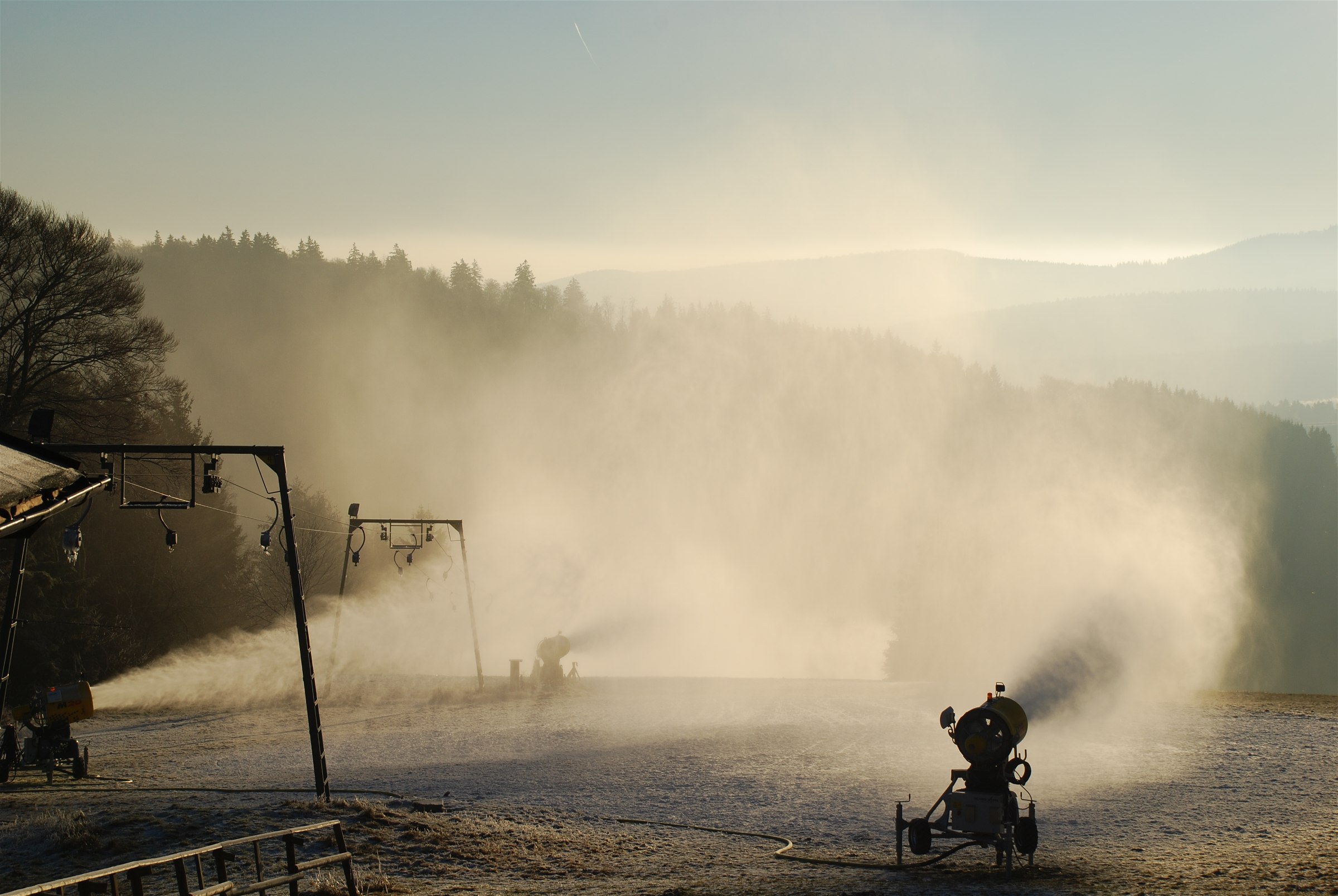
In the 1990s, other lift operators gained their first experience with mass-produced snow cannons. The first successful snow production using mass-produced snow cannons was carried out by the Willingen Ski Club in 1991 at the Mühlenkopfschanze. In the winter of 1994/1995, a snow cannon was installed for the first time in the Ruhrquelle ski resort, and thus on a piste used by tourists.
Due to their significantly lower efficiency at that time, they were initially used only for snowmaking on lift tracks or selectively in areas with a very thin layer of snow.
At the beginning of the millennium, initiated by the Winter Sports Arena Master Plan, snowmaking using high-performance snowmaking systems began on a larger scale with the 2002 pilot project in Neuastenberg, which proved that skiing with the support of technical snowmaking is possible on an economic basis not only in the Alps, but also in the low mountain ranges. The Winter Sports Arena master plan initiated a development towards the most important winter sports region north of the Alps.
Devices have become more powerful and efficient
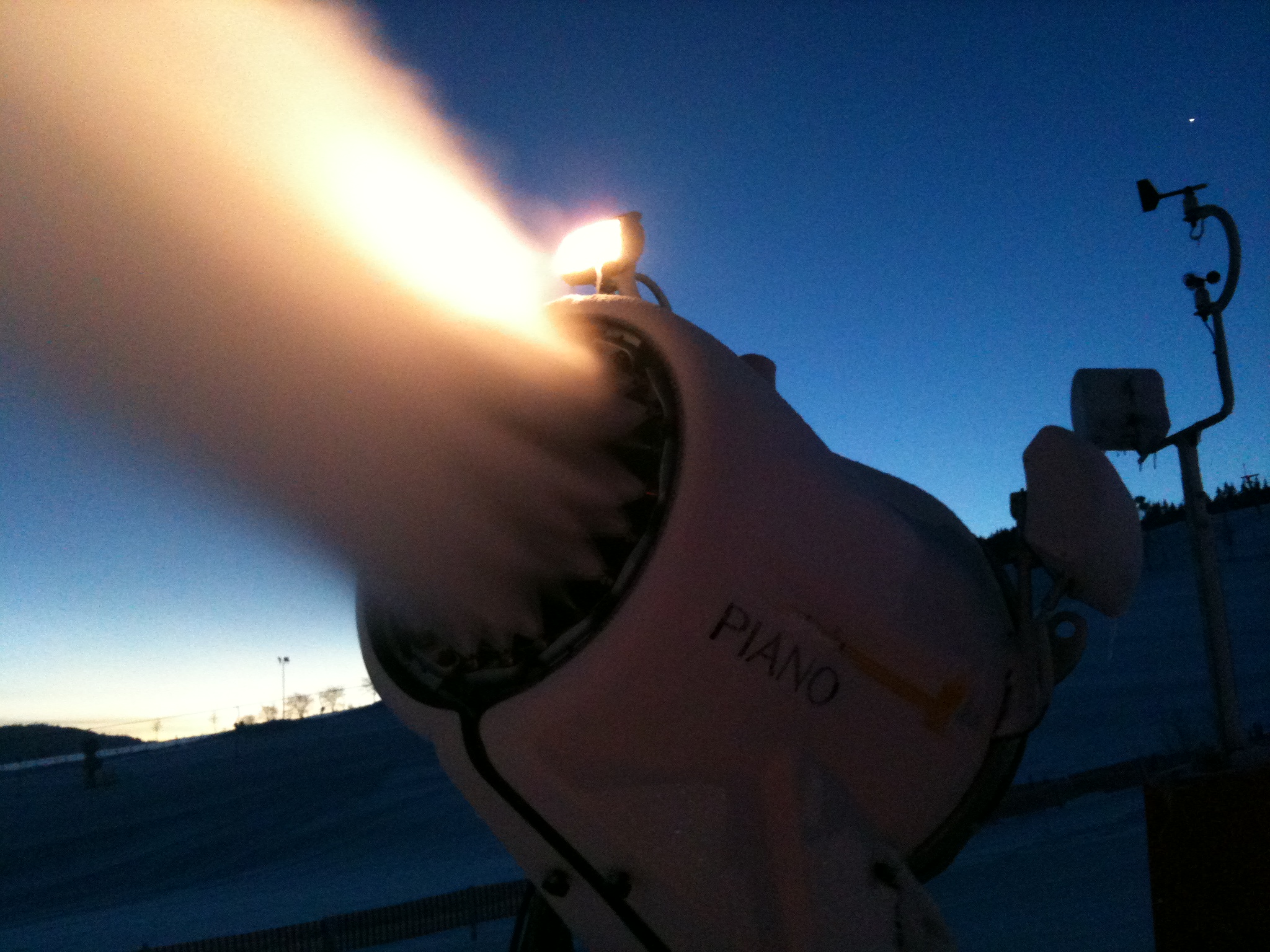
In the Sauerland winter sports arena, there are mainly snow lancesand low-pressure snow propellers. These have become increasingly efficient and energy-saving over the years. In 2023, for example, twice as much snow can be produced with the same amount of energy as in 2000.
The temperature limit has also continuously shifted upwards. Whereas at the beginning of the century it was still -3 degrees, by 2023 it was already possible to produce snow efficiently at -1.5 degrees with correspondingly cold water.
Another technical development took its course in 2015. The Ruhrquelle ski resort successfully deployed a flake ice system that can produce snow regardless of the outside temperature. Using cooling technology, the water is cooled to freezing point in an efficient heat exchanger. A scraper removes it in wafer-thin flakes of ice, which are distributed over the slope to produce a kind of firn snow.
The system is now located in the Winterberg ski lift carousel on the Poppenberg. It is not used for comprehensive snowmaking, but for targeted, selective use, for example around the Snowboard World Cup. Other systems are also located on the Poppenberg, in the Rauhen Busch and on the Schneewittchenhang bridge.