


How does snowmaking work ?
Clear water without additives
Snow consists of many small ice crystals, most of which are highly branched. The exact shape of snowflakes depends on the temperature, the level of humidity, the height from which they fall and the effect of wind drift at the time of formation. Like natural snow, artificially produced snow consists of frozen water.
The differences lie primarily in structure and density, not in composition. It consists of ice crystals, which are nothing more than frozen water without any added substances. No additives are added to the water during snowmaking.
Therefore, the term ‘artificial snow’ is not a technically correct description for snow produced in this way.
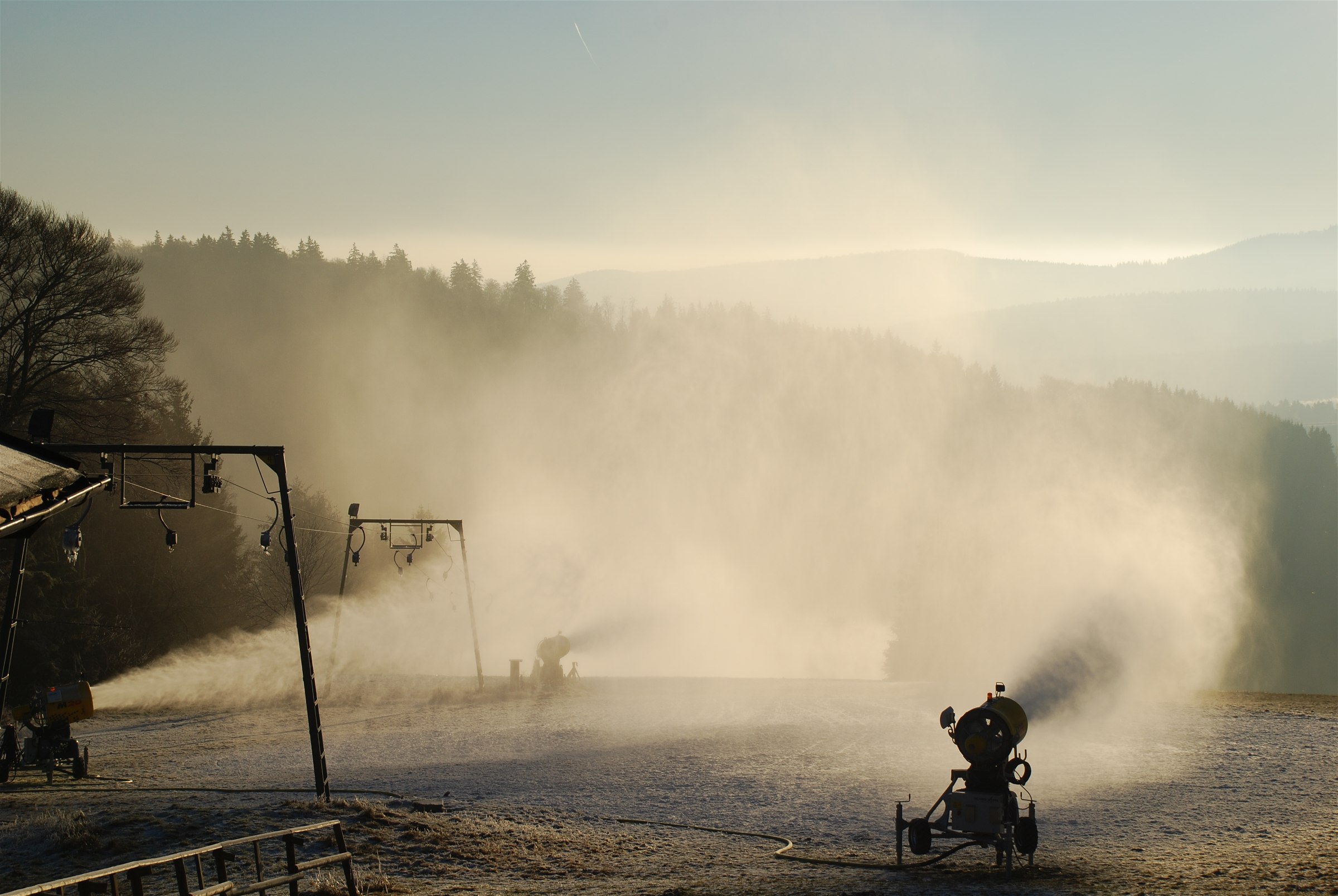
During the snowmaking process, water is mixed with air, forced through a nozzle under high pressure and finely atomised by a blower. As the tiny water droplets drift to the ground, they freeze in the cold air. Because they freeze more quickly on their short journey to the ground, the crystals formed during artificial snowmaking do not develop fine branches but rather take the form of round snow grains. This is why this snow is denser and more compact than natural snow and melts less quickly.

Water freezes in the cold air
At the Sauerland Winter Sports Arena, almost exclusively conventional snowmaking is used. In this process, the finely atomised water freezes on contact with the cold air. This means that snow guns can only produce snow when the ambient temperature is sufficiently low. The air must be at least minus two degrees, preferably lower. This is because snow production is more effective at these temperatures. Snow guns achieve their optimum output at temperatures of minus ten degrees.
Low humidity also has a positive effect on snowmaking results. In particularly dry conditions, the systems can even produce snow at temperatures just above 0 degrees. The amount of snow a snowmaker can produce depends on the ambient temperature. At minus three degrees, around nine cubic metres of snow are produced per hour; at minus ten degrees, around 60 cubic metres.

Snow cannons and snow lances
At the Sauerland Winter Sports Arena, propeller-driven machines (‘snow cannons’) and snow lances are used. Lances are more energy-efficient, but require slightly lower temperatures. Furthermore, there is greater loss due to snow being blown away. For this reason, the vast majority of snow-making machines are propeller-driven. These look like an aeroplane engine. In the centre of the machine is a propeller that generates a powerful airflow. Surrounding it are several rings of nozzles.
This is where the mixture of water and compressed air is discharged.
A snow lance is an aluminium tube up to twelve metres long, with fine nozzles at its tip. A mixture of air and water is blown through these. The water is atomised into fine droplets, which then also drift to the ground as fine ice crystals when exposed to the cold air.

Store cold like in a refrigerator
The snow is deposited directly onto the slope, which is then groomed straight away. Alternatively, it is piled up into large mounds and stored in these depots. The snow produced and stored in this way provides a significantly more robust and durable base than natural snow. This is not only because artificially produced snow melts more slowly due to its coarser ice crystals. The snow cover and depots form a thin, protective layer of ice on the outside. Inside, temperatures remain cold.
This means the temperature is maintained for a long time, just like in a fridge. On the slopes, the grooming machines ensure that a very compact layer of snow is created, which also offers a high level of protection against any mild outside temperatures.
When temperatures are slightly above freezing, well-groomed snow can remain stable for a long time, particularly in dry air. Well-groomed slopes or man-made snow deposits can also withstand mild spells lasting several weeks, provided there is no precipitation. This is precisely the principle behind artificial snowmaking: using cold spells to produce snow in order to bridge mild periods. That is why the average winter temperature is only a relative measure for assessing snow reliability.

All-weather snow gun
For several years now, all-weather snow-making machines have been in use on a number of slopes; these are capable of producing snow regardless of the outside temperature. Initially, these were individual units installed for testing and development purposes. Now, at the Winterberg ski lift complex, five to six consecutive kilometres of slopes can be supplied with snow in this way when required.
The technology has now proven its worth and energy consumption has been steadily reduced.
If all-weather snow-making machines were classified by energy efficiency class in the same way as fridges, newer systems would achieve efficiency class C, whilst the latest-generation systems would even reach efficiency class A.
Wherever cold is produced, heat is generated. A pilot project is making it possible to utilise the waste heat from these systems to heat a multi-purpose building housing a restaurant, ski hire, ticket office and staff accommodation. The system delivers up to 95 kW of usable heat output for heat recovery. A heat pump for a detached house with 100 to 150 square metres of living space typically provides around 5 to 7.5 kW of heating output. This improves the energy balance once again very significantly.